Tanisha

BlogThe Ultimate Guide: Organic vs. Paid Marketing-Which One is Right for You?

The Ultimate Guide: Organic vs. Paid Marketing-Which One is Right for You? In today’s digital world, every business wants more visibility, traffic, and customers. Whether you’re a startup or a small business owner, marketing plays an important role in your growth. But when it comes to online marketing, one common question arises: Should you invest in organic marketing or paid marketing? Both organic and paid marketing can help your business succeed. The best choice depends on your goals, budget, and how quickly you want to see results. Let’s explore the differences between organic and paid marketing : What Is Organic Marketing? Organic marketing refers to all the methods used to attract customers naturally without directly paying for advertising. Some common examples include: The goal of organic marketing is to build trust, authority, and long-term relationships with your audience. Advantage of organic marketing Disadvantages of Organic Marketing Organic marketing is like planting a tree. It takes time to grow, but once it does, it provides benefits for years. What Is Paid Marketing? Paid Marketing is a marketing strategy where businesses pay to promote their products, services, or content to a targeted audience. Some common examples include: With paid marketing, businesses can instantly reach their target audience and generate traffic quickly. Advantages of Paid Marketing Disadvantages of Paid Marketing Paid marketing is like renting a house. You get immediate access, but the benefits stop when you stop paying. Organic Marketing vs. Paid Marketing: Key Differences Factor Organic Marketing Paid Marketing Cost Low investment Requires ad budget Results Long – team Immediate Traffic Duration Sustainable Temporary Trust Level Higher Moderate Scalability Slower Faster ROI Timeline Long -team Short -team When Should You Choose Organic Marketing? Organic marketing is ideal if: For example, if you’re a Digital Marketing Specialist, publishing informative blogs and optimizing your website can help you attract visitors continuously without paying for every click. When Should You Choose Paid Marketing? Paid marketing is a great option if: For example, an e-commerce store launching a festive sale can use Google Ads and social media ads to drive instant traffic and sales. Can Organic and Paid Marketing Work Together? Absolutely! Many successful businesses use a combination of both organic and paid marketing to maximize their results. For example: This balanced approach helps businesses achieve both short-term wins and long-term growth.

BlogThe Ultimate Guide: Organic vs. Paid Marketing-Which One is Right for You? Read More »
“A clean social media engagement illustration showing a smartphone in the center with floating likes, comments, shares, and direct message icons around it.”

How Social Media Marketing Can Increase Brand Awareness

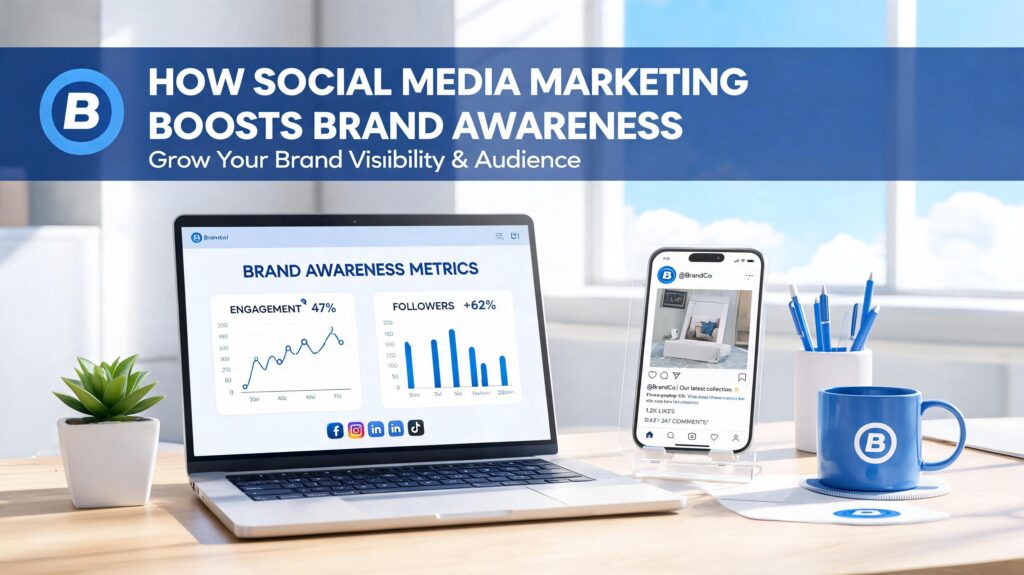
How Social Media Marketing Can Increase Brand Awareness Social media marketing increases brand awareness by putting your brand in front of the right audience repeatedly, in places where they already spend time online. It helps people recognize your name, remember your message, and start trusting your business over time. Brand awareness is how familiar people are with your brand, products, or services. The more often people see your brand in useful, interesting, and consistent ways, the more likely they are to remember it when they need what you offer. Social media is especially effective because it combines reach, sharing, engagement, and visual storytelling in one place. How social media builds awareness Social media marketing increases awareness in a few important ways: When people repeatedly see your brand in their feed, your business starts to feel familiar, and familiarity drives recognition. Best strategies to use To grow brand awareness effectively, focus on these tactics: A brand that feels active and engaging is more likely to be remembered than one that only posts promotions. Why engagement matters Engagement signals that people are noticing your content. Likes, shares, saves, comments, and mentions all help platforms show your content to more people. The more engagement your content gets, the more visibility it can earn, which creates a cycle of awareness and discovery. This is why brands that ask questions, run polls, and invite feedback often grow faster than brands that only advertise. Simple example A local clothing brand posts styling videos, customer photos, behind-the-scenes clips, and seasonal offers on Instagram and Facebook. People start recognizing the brand’s style, sharing posts with friends, and tagging the brand in their own photos. Over time, the brand becomes more familiar to potential buyers, even among people who have never purchased before. Blog version for website How Can Social Media Marketing Increase Brand Awareness? Social media marketing is one of the most effective ways to increase brand awareness in today’s digital world. It helps businesses connect with larger audiences, build recognition, and stay visible in a crowded market. By sharing valuable content, engaging with followers, and creating a consistent brand presence, businesses can turn casual viewers into loyal customers. Unlike traditional advertising, social media allows brands to interact directly with their audience. This makes it easier to build trust, encourage sharing, and create a memorable identity. Whether you are a small business or a growing company, social media can help your brand reach the right people at the right time. 1. Reach More People Social media platforms give your brand access to large and diverse audiences. When you post content regularly, your business can appear in feeds, explore pages, and recommended content areas, helping you reach people who may not have heard of you before. 2. Build a Consistent Brand Identity A strong brand is easy to recognize. Using the same colors, tone, logo, and message across social platforms helps people remember your business. Consistency makes your brand look professional and trustworthy. 3. Share Content People Want Helpful tips, entertaining videos, behind-the-scenes posts, and customer stories are more likely to be shared. When people share your content, they introduce your brand to new audiences and increase awareness naturally. 4. Encourage Engagement Engagement builds familiarity. Replying to comments, asking questions, running polls, and responding to messages helps your audience feel connected to your brand. The more interaction you create, the more visible your content becomes. 5. Use Influencers and User Content Partnering with influencers or encouraging customers to post about your brand can expand your reach. People often trust recommendations from creators and real customers more than ads, which makes this a powerful awareness strategy. 6. Stay Visible Over Time Brand awareness does not grow overnight. Regular posting, active engagement, and ongoing promotion help keep your business in front of your audience. Over time, repeated exposure makes your brand easier to remember. Conclusion Social media marketing increases brand awareness by improving visibility, encouraging engagement, and helping people remember your brand. With the right content and a consistent approach, social platforms can become one of your strongest tools for building recognition and trust.

How Social Media Marketing Can Increase Brand Awareness Read More »

Blog

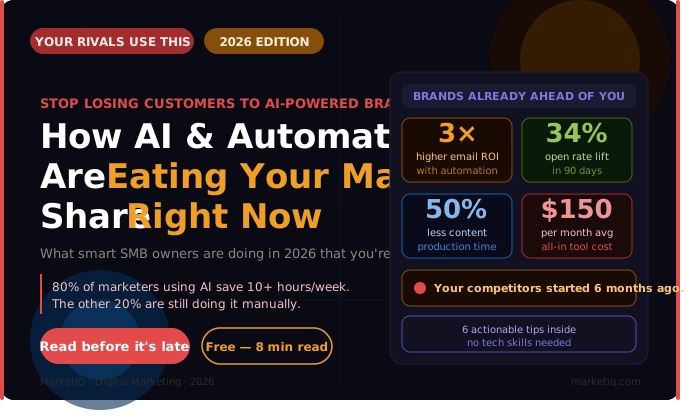
If you’ve been running a business for any amount of time, you’ve probably heard the buzz around AI and automation. Honestly? The noise is warranted. We’re living through one of the most significant shifts in how marketing actually gets done — and the good news is that you don’t need a massive budget or a tech team to take advantage of it. I’ve spent years helping businesses of all sizes integrate AI-powered tools into their marketing strategies, and I can tell you firsthand: the playing field has never been more level. Small and medium-sized businesses now have access to the same smart, scalable tools that Fortune 500 companies use — often for a fraction of the price. Let me walk you through what this really means for your business. 80%of marketers using AI report time savings on content tasks3×higher ROI seen by businesses automating email workflows$2.6Tprojected business value added by AI in marketing by 2026 Benefits of AI and AutomationLet’s be direct: the biggest reason businesses are turning to AI and automation is cost-efficiency. But that’s just the headline. Here’s what it actually looks like in practice: Time savingsAutomate repetitive tasks like email sequences, social scheduling, and ad reporting — freeing hours every week.Smarter targetingAI tools analyze customer behavior in real time, letting you reach the right person with the right message.Reduced ad spend wasteProgrammatic ad platforms use AI to optimize bidding and placements, cutting wasted spend dramatically.Personalization at scaleDeliver personalized email content or website experiences to thousands of users without manual effort.Better decisions, fasterAI dashboards surface insights instantly — no more waiting for weekly reports or manual spreadsheet updates.24/7 customer engagementAI chatbots handle common queries around the clock, converting visitors even when your team is offline. Real-world example: A small e-commerce brand I worked with switched from manual email campaigns to an AI-driven email platform. Within 90 days, their open rates increased by 34% and they cut their content production time in half — while spending less than $150/month on the tool. The Challenges (Let’s Be Honest) I wouldn’t be doing you any favors if I only talked about the upsides. Here are the real challenges I see business owners run into — and why knowing them upfront saves you time and money: 6 Actionable Tips to Get Started Here’s where I want to give you something concrete to walk away with. These are the steps I recommend to every business owner who’s just starting to explore AI and automation: 1.Start with email automation. It’s the highest-ROI entry point. Tools like Mailchimp, Klaviyo, or ActiveCampaign let you build automated welcome sequences, abandoned cart emails, and re-engagement flows with minimal setup. Pick one, integrate it with your store or CRM, and build your first sequence this week. 2.Use AI for content ideation, not just creation. Tools like ChatGPT or Claude are excellent brainstorming partners. Use them to generate 20 blog topic ideas, draft social captions, or write A/B test variations for your ads — then edit and personalize the output with your brand voice. 3.Deploy a basic chatbot on your website. Even a simple FAQ bot can reduce customer service load by 30–40%. Tools like Tidio or Intercom offer free tiers and can be live on your site in under an hour. This is one of the fastest wins available. 4.Clean your data before automating anything. Audit your email list, tag your customers by purchase behavior, and make sure your analytics are tracking correctly. Thirty minutes of data cleanup now will dramatically improve the performance of every AI tool you use later. 5.Run small experiments before scaling. Don’t overhaul your entire marketing stack at once. Pick one channel, implement one AI-powered tool, run it for 30 days, measure the results, and then expand. This approach reduces risk and helps you build internal confidence with the technology. 6.Use AI analytics to spot your best customers. Platforms like Google Analytics 4 now have built-in predictive metrics (purchase probability, churn probability). Use these signals to identify high-value segments and focus your limited marketing budget where it will have the greatest impact. The bottom line? AI and automation in digital marketing aren’t about replacing your creativity or your team — they’re about multiplying what you can do with the time and budget you already have. The businesses that will win over the next five years are those that learn to use these tools strategically, not just reactively. You don’t need to be a tech expert. You just need to start. Pick one tool, one channel, and one goal. Build from there. The learning curve is far shorter than most people expect — and the results can show up quickly. If you’re unsure where to begin, start with email automation this week. It’s the fastest path to a measurable return, and once you see it working, everything else becomes a lot less intimidating.

Blog Read More »

How AI and Automation Impact Digital Marketing Today

If you’ve been running a business for any amount of time, you’ve probably heard the buzz around AI and automation. Honestly? The noise is warranted. We’re living through one of the most significant shifts in how marketing actually gets done — and the good news is that you don’t need a massive budget or a tech team to take advantage of it. I’ve spent years helping businesses of all sizes integrate AI-powered tools into their marketing strategies, and I can tell you firsthand: the playing field has never been more level. Small and medium-sized businesses now have access to the same smart, scalable tools that Fortune 500 companies use — often for a fraction of the price. Let me walk you through what this really means for your business. 80%of marketers using AI report time savings on content tasks3×higher ROI seen by businesses automating email workflows$2.6Tprojected business value added by AI in marketing by 2026 Benefits of AI and Automation Let’s be direct: the biggest reason businesses are turning to AI and automation is cost-efficiency. But that’s just the headline. Here’s what it actually looks like in practice: Time savingsAutomate repetitive tasks like email sequences, social scheduling, and ad reporting — freeing hours every week.Smarter targetingAI tools analyze customer behavior in real time, letting you reach the right person with the right message.Reduced ad spend wasteProgrammatic ad platforms use AI to optimize bidding and placements, cutting wasted spend dramatically.Personalization at scaleDeliver personalized email content or website experiences to thousands of users without manual effort.Better decisions, fasterAI dashboards surface insights instantly — no more waiting for weekly reports or manual spreadsheet updates.24/7 customer engagementAI chatbots handle common queries around the clock, converting visitors even when your team is offline. Real-world example: A small e-commerce brand I worked with switched from manual email campaigns to an AI-driven email platform. Within 90 days, their open rates increased by 34% and they cut their content production time in half — while spending less than $150/month on the tool. The Challenges (Let’s Be Honest) I wouldn’t be doing you any favors if I only talked about the upsides. Here are the real challenges I see business owners run into — and why knowing them upfront saves you time and money: Actionable Tips to Get Started Here’s where I want to give you something concrete to walk away with. These are the steps I recommend to every business owner who’s just starting to explore AI and automation: The bottom line? AI and automation in digital marketing aren’t about replacing your creativity or your team — they’re about multiplying what you can do with the time and budget you already have. The businesses that will win over the next five years are those that learn to use these tools strategically, not just reactively.You don’t need to be a tech expert. You just need to start. Pick one tool, one channel, and one goal. Build from there. The learning curve is far shorter than most people expect — and the results can show up quickly.

How AI and Automation Impact Digital Marketing Today Read More »

HAPPY

Mother's

DAY

45% Coupon Code

Yes! I Want to Save 25%
No thanks I don't want to save